Archive for the ‘Uncategorized’ Category

COFES Institute Interview with Mark Papermaster, CTO and SVP Advanced Micro Devices (AMD)

Posted on April 9th, 2018 in Uncategorized | No Comments »

Steve Waite: It is terrific to speak with you today, Mark. You have a lot of experience in technology. Tell us about your background.

Mark Papermaster: I’ve been very fortunate because I have had a chance to be a part of a very exciting time in the industry. I started with IBM in the early 1980s in the mainframe era during the time of transition from microcomputers to personal computers. While I was at IBM I had a chance to work on the NASA Space Shuttle program. I also got to work on chip design. Many years later, Steve Jobs recruited me to Apple to run iPod and iPhone development which I did for a couple of years. It was an exciting time at Apple. We were innovating at an extremely high level.

SW: You certainly were! I had never seen anything like it. The level of innovation was astonishing during that period.

MP: We were designing new electronics, new industrial design, new user interfaces, adding FaceTime, instant messaging capability, adding cameras. It was a time of massive innovation. It was a phenomenal experience!

SW: I can only imagine. You went to Cisco after Apple, correct?

MP: Yes. I was at Cisco for a brief period after Apple. I ran all of its switching and routing technology. My experience at IBM, Apple and Cisco gave me an opportunity to work on just about every aspect of products that AMD serves with its technology.

SW: You were getting the experience you needed for the ultimate job as CTO of AMD.

MP: In retrospect, yes. But it certainly wasn’t planned that way. That is just how things worked out. One of the Board members at AMD who was the former head of R&D at IBM, Nick Donofrio, recruited me. He knew me well from our days at IBM. Nick took the lead to recruit me to be the CTO and run Technology and Engineering at AMD. At the time, people had written off AMD. They said the company was a great technology company, but competitors had passed it by. I looked at the company. I had worked with it over the years and was a customer. I knew it to be a great company of innovation with great engineers. Historically, it had not been able to consistently drive that innovation to market. I viewed the offer from AMD as a phenomenal opportunity to make a difference in the industry.

SW: Tell us about your current role as the company’s CTO.  

MP: There’s a major opportunity today to harness the data explosion with AI, Machine Learning and Big Data analytics on the one side, and with AR and VR on the other – to be able to visualize and manage the data while fundamentally changing how we as humans’ interface with computing technology. One of my strengths is being able to pull bright people together with a focused game plan and make a difference by repeatedly driving technology with leadership in the market. When you can do this, it is a beautiful thing. It is truly an exciting time at AMD. We launched a new line of products in 2017 from top to bottom. We have a very strong roadmap behind it.

SW: That is wonderful to hear. Speaking of a roadmap, Moore’s Law has been a driving force of innovation over the forty years in the industry. What is your perspective on Moore’s Law and the future development of microprocessors?

MP: We are shipping the AMD “Zen” processor core today with 14 nanometer FinFET for PCs, servers and embedded devices, as well as graphics. Our next generation is 7 nanometers. We skipped 10 nanometers because we wanted a step-wise progression of density. At 7 nanometers, we can practically double the number of transistors on a chip. Our first 7 nanometer designs are in build now and we expect them to be available for sampling at the end of this year and go into production in 2019.

SW: Very good! Looking ahead, how much more performance can we get out of silicon?

MP: The technology nodes are slowing down as we go from 14 to 7 and below 7 nanometers. But this doesn’t mean that Moore’s Law is dead. We are entering a period that I call Moore’s Law Plus. It is not just the device transistor. You still need the new process technology node. The key is how you put it together. At AMD we are looking at how we think about it from a system standpoint. For example, thinking not just about CPUs, but CPUs with accelerators, and specifically leveraging the GPU as an accelerator. That is, we are exploring the ability to integrate solutions to the system level – hardware and software.

One of the strengths we have at AMD is we can be more agile than others. If you look at our new CPU products, you will see we already have a multi-chip approach. When you look at AMD Radeon™ graphics, our high-performance graphics processor line that is based on our current “Vega” architecture, it is using stacked memory on a silicon-to-silicon connector. The GPU connects to the memory over silicon. It is called 2.5D packaging. With this type of thinking at a systems level, even when Moore’s Law slows down, we can integrate devices in a novel way so that AMD can economically bring performance to its customers in the future.

SW: I see. That approach makes a lot of sense. Are there any other materials beside silicon on the AMD roadmap?

MP: From a new materials standpoint, there is a lot of innovation coming through the fabs. AMD is a fabless company. The 7-nanometer technology uses some new materials as well as new lithography. At this node we will see foundries beginning to use EUV or Extreme Ultra Violet lithography. On the near term, as a fabless company, we are really focused on leveraging the best technologies that are in the fabs. More importantly, we are focused on driving the system design to bring better solutions to our customers and to provide leadership in high performance, both compute and visualization.

SW: We are seeing a lot of interest in AR and VR, as well as AI and Machine Learning these days. What’s your perspective on these emerging technologies?

MP: To me, AR and VR really represent a revolution and how we as individuals interface with computing. AR and VR change our interaction to an immersive environment. That can only be enabled with a very, very high performance and low latency device. Otherwise, you get an imperfect experience. Your body cannot be fooled by imperfection. If it sees lags, if it sees any drop in that interaction, immediately your brain realizes you are not in a virtual reality. You are in a manufactured, simulated experience that seems fake versus truly being immersed and transported.

For us at AMD, this is a phenomenal opportunity. This is what we do. This is what drives our engineers. They have a passion to create that kind of performance, not only in visualization through the graphics processing engine, but through our whole multimedia stack driving our codecs, driving very efficient translation to the standards for transmission and compression. Figuring out how we wirelessly bring that from a headset to a computer that is doing the heavy lifting, to our PC and Workstation-based computing, this type of thing is a grand challenge for the engineers at AMD and one they are taking head on.

SW: Excellent! Very exciting stuff, Mark. What about AI and Machine Learning? What’s your perspective on these emerging technologies?

MP: You look at AI and Machine Learning. It has the potential to really make use of all the data being generated today. We are all surrounded by sensors. We have all heard the projections of 50 billion connected devices by 2020, and it certainly seems to be on that pace. AI and Machine Learning become a requirement to actually utilize all of that data. It also requires high performance. If you want to take all that data, categorize and classify it, and make it useful, you end up having to run teraflops upon teraflops of training, typically at a data center level, to be able to create the patterns that allow you to tackle new data very efficiently. Now that you have trained that data, then you can much more efficiently run inference on any new data as it comes in. Typically for training, this all requires devices like GPUs. Our GPUs are excellent at providing the kind of teraflops required for training.

At the edge of the network, and in the actual interference devices, it is typically a CPU, GPU or a specialized device. AI and Machine Learning are great for the semiconductor industry. It needs high performance and it needs enabling software. At AMD, we have the high-performance hardware. What is exciting for us is that at the start of this year we announced production-level for machine intelligence software enablement, called ROCm 1.7, or Radeon Open Ecosystem. And we have done this open source. We also created GPUOpen. You can go to gpuopen.com and look at this initiative.

SW: So open source software is now part of AMD’s innovation engine. That seems like an important shift for the company.

MP: AMD has always appreciated the importance of software, and we are long-time supporters of open source and industry standards. The company has a rich history in visualization. We have always had a huge team working on driver development. What we learned a long time ago is that you have to provide the graphics engine, but it is the device drivers that really bring the ongoing performance improvements and the adaptation required to evolve.

Machine Learning is a great example of this. Our competitor had a lead on the software for machine intelligence. We had to come from behind. Over the last three years we made a concerted effort to get to production level with that enablement. We have added our staffing at a higher rate for software engineers versus hardware engineers given the demand we are seeing associated with AI and Machine Learning technologies, as well as AR and VR applications.

SW: What’s your perspective on blockchain as a disruptive technology?

MP: Blockchain, by its very nature, is a distributed ledger system. It has a huge range of applications. Cryptocurrency is just one. I think blockchain truly has the potential to disrupt any industry where you have contracts and payment systems that today have a middle layer. Blockchain is able to eliminate the middleperson.

From a technology standpoint, blockchain requires high performance compute because, as a distributive system, you need to validate those transactions across the network. There is a proof algorithm that needs to be run which, yet again, requires a CPU, GPU or a specialized device. The blockchain drives up the demand for compute efficiency. I see blockchain as another mega trend along with AR, VR, AI and Machine Learning with the ability to disrupt and yet is dependent on very efficient, high performance computing.

SW: I have one last question for you, Mark. What advice would you give to the younger generation of tech entrepreneurs coming up today?

MP: The biggest advice is to follow your passion. When you have a passion for an area of technology or an application, you are a driving force and can focus on where you want it to be better. You want to get better products out that can make a difference in people’s lives and in the industry. You cannot have a better motivator for innovation for yourself or for teams you work with than having passion for what you do.

SW: Terrific advice, Mark! It has been wonderful spending time with you today. Thank you again for your time. We look forward to listening to you speak at the upcoming COFES event. All the best with your endeavors at AMD.


COFES Institute Announces Dr. Keith Schubert as a Keynote at COFES 2018

Posted on April 4th, 2018 in Uncategorized | No Comments »

COFES Institute Announces Dr. Keith Schubert as a Keynote at COFES 2018

The COFES Institute is delighted to announce the third keynote speaker, Dr. Keith Schubert, for COFES 2018, to be held in Scottsdale, Arizona, on April 12-15, 2018 at the Scottsdale Plaza Resort. Attendees will benefit from the talent and wisdom of a trailblazer who is a longtime collaborator with the director of NASA’s Astrobiology Institute and works with researchers at numerous other leading-edge organizations.

“The work that Dr. Schubert is doing, to my awareness, has never been done before. Not only do I believe it is unique in our search for life in the universe, but this genre of work is groundbreaking because it lets us see something new about our own context through the eyes of a machine,” said Nathanael Miller, COFES Institute Board Director. “This topic fits perfectly into the COFES 2018 theme designed to stretch the thinking of our attendees.”

The three COFES keynote speakers will challenge attendees to imagine and explore new futures and possibilities for themselves, their businesses, and their communities through this year’s theme, Human-Aided Design: Changing the Relationship between Our Tools and Us. The annual four-day event for the design and engineering software industry brings together a diverse group of thought leaders in technology and science to engage in wide-ranging and meaningful discussions. To request an invitation, visit apply.cofes.com.

Dr. Schubert’s current challenge is working with NASA researchers to develop a system to detect life forms in outer space that could be significantly different than life on Earth without consuming limited resources like chemical tests. How do you invent machines and processes that can detect life when that lifeform is likely to be very different from what we know? Moreover, the added difficulty in space is that this process has to be carried out without adding weight or impacting primary objectives, so relying on digital photography, sensors, and artificial intelligence are crucial.

Dr. Schubert’s expansive knowledge in software, engineering, and medical imaging provides the foundation for his keynote address, Unlocking the Patterns of Life: What Limited Resources and Computers Can Teach Us About Life and Everything.

“It is about unsearched systems and how do you search for what you do not know,” said Dr. Schubert about his topic. “With the use of artificial intelligence and software tools, we can discover the quintessential aspects of a problem you do not know the answer to and that is what I want to discuss.” His incredible journey doing field research on several NASA Spaceward Bound expeditions, and as one of the team leads on a National Geographic expedition has allowed him to discover universal indicators to the unknown problems often based on pattern recognition and then developing software tools to detect. “We leverage insights in order for tools and human beings to come together.”

“Dr. Schubert’s keynote will be thought provoking to say the least,” said Vincent Caprio, COFES Institute President. “Other keynotes for COFES this year will be entrepreneur Ping Fu speaking about resilient design and machine learning. Lastly, venture capitalist George Gilder discussing his latest book Life After Google. These three people will bring ideas that will stretch the thinking of our attendees.”

About Dr. Keith Schubert
Dr. Schubert is a full professor in the Electrical and Computer Engineering Department at Baylor University. His interest areas are the fast, numerically stable solution of large, sparse problems, particularly for medical imaging and treatment; the design of electrical and embedded systems for medical and biological applications; the patterned growth of extremophiles and the search for life in space; and the mathematical modeling of synchronization. Dr. Schubert has been a team leader on the December 2012 National Geographic expedition to Cueva de Villa Luz in Mexico, and his work made the cover article of National Geographic July 2013.  Dr. Schubert has worked on medical projects with Loma Linda University (LLU), LLU Medical Center, University of California San Francisco, Baylor Scott and White Medical centers in Dallas and Temple, and holds an adjunct full professor position at LLU.  Dr. Schubert’s medical projects range from developing proton computed tomography to functional near-infrared spectroscopy (fNIRS) brain monitoring to artificial intelligence for colonoscopy.

About COFES and the COFES Institute
Now in its 19th year, COFES is the annual, invitation-only event for the design and engineering software industry. Widely recognized as a think-tank event, COFES (cofes.com) gathers design and engineering software leaders (vendors, users, press, and analysts) together to discuss the role engineering technology will play in the future survival and success of business. COFES is renowned for hosting leading keynote visionaries that provide a new perspective to the future of the industry. Apply for an invitation at apply.cofes.com.

The COFES Institute was created in 2017 to provide sustainable leadership to COFES. The COFES Institute is a non-profit 501c3 governed by a Board of Directors led by Vincent Caprio. Other members of the board are (in order of last name): Jim Brown: President – TechClarity, Jim Doxey: Product Configuration Manager – Oculus, Nathanael Miller: Aerospace Engineer – NASA Langley Research Center, Jason Preston: Co-Founder – Parnassus Group (DENT), and Rebecca Yeh: Event Director & Secretary – COFES. In addition, the COFES Advisory Board was established to provide industry input to the COFES Board, see the COFES website for a listing of the Advisory Board participants.

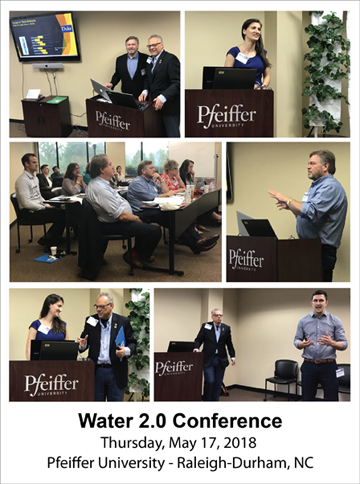
Speaker Announcement: Water 2.0 Conference – May 17th Pfeiffer University Raleigh-Durham NC

Posted on March 19th, 2018 in Uncategorized | No Comments »

Water 2.0 would like to share a speaker announcement for our:


Water 2.0 Conference: Digitally Connecting the Water Industry
May 17, 2018 – Raleigh-Durham NC

$250 REGISTER TODAY

CONFERENCE LOCATION


Pfeiffer University Raleigh-Durham Campus
2880 Slater Road Suite 100
Morrisville, NC 27560


The Water 2.0 Conference: Digitally Connecting the Water Industry will focus on the use of data analytics, software, cyber security for water utilities and industrial water users. Participants will include water and energy industry authorities, utilities professionals and representatives from the EPA.


Water Enters the Digital Era. Big Data Solutions, Information Powered Utilities and Smarter Customers

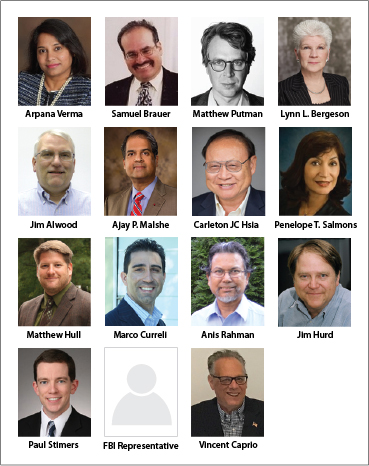
Speakers for the Raleigh-Durham Water 2.0 Conference include:


Colleen Perry Keith, PhD, President, Pfeiffer University

Kenneth E. Russell, PhD, Vice President, Digital Transformation and CIO, Pfeiffer University and Author of Social Knowledge

Adam Tank, Founder & CEO, Industrial Optic

Alan Hinchman, Vice President, Gray Matter Systems

Mark Modzelewski, General Manager, Treeline Interactive

Brian Fannon, PhD, Watershed Investigator for Yadkin Riverkeeper

Karen Sorber, Executive Chair/CEO, Micronic Technologies

Scott Livingston, Chairman & CEO, Livingston Securities LLC

Erik Hromadka, CEO, Global Water Technologies, Inc.

Becky Scott, Senior Solutions Architect, Lithium Technologies

FBI Representative

Jim Hurd, Director, GreenScoence Exchange

Vincent Caprio, Water 2.0 Executive Director & Conference Chair

—————————————————————————
Questions in regard to the event may be directed to:

Matt Malandro, Conference Manager matt@water2.org

Click here to see completed Water 2.0 events.

—————————————————————————
WATER NEWS

Carolina Water says its water is clean, lead-free. They set out Tuesday to prove it.
The Herald

California to add recycled sewer water to the state reservoirs
Fox News

Thinking of drinking “raw water”? Why health experts say beware.
The Herald Sun

Tens of millions of Americans exposed to unsafe drinking water each year
USA Today

Bottled Water, Brought to You by Fracking?
Food & Water Watch

10 Breakthrough Technologies 2018
MIT Technology Review

—————————————————————————
I hope you will be able to join us in Raleigh-Durham on May 17th!

COFES Institute Announces Ping Fu as a Keynote at COFES 2018

Posted on March 12th, 2018 in Uncategorized | No Comments »

Technologist, Entrepreneur and Author to keynote at The Congress On the Future of Engineering Software (COFES)

The COFES Institute is pleased to announce technologist, entrepreneur and author Ping Fu, as a keynote speaker at COFES 2018 in Scottsdale, Arizona, April 12-15, 2018 at the Scottsdale Plaza Resort. Ms. Fu has been a major contributor in the engineering software arena and is currently the Executive Chairman of Gelsight (gelsight.com).

The theme for COFES 2018 is Human-Aided Design: Changing the Relationship between Our Tools and Us. Ping will discuss the theme for COFES with a focus on machine learning and resilient design. The annual four-day event for the design and engineering software industry brings together a diverse group of thought leaders in technology and science to engage in wide-ranging and meaningful discussions. To request an invitation, visit apply.cofes.com.

“Ping is the ideal person to lead off COFES as the opening keynote,” said Vincent Caprio, COFES Institute President. “She has been part of the computing evolution for decades and more importantly has been an innovator in the engineering software space. I know she will provide a thought-provoking foundation for our theme.”

“Resilient design and machine learning are two subjects I am focusing on now,” said Fu. “Both of these topics are integral to this year’s COFES theme. Resilient design is not about designing something that never fails but designing with known failure characteristics that can be repaired very quickly. With this type of design process, you confront failure head on and incorporate it into the design. You anticipate failure and seek ways to rapidly address the failures. With machine learning, we can outsource part of our brain to machines, which perform certain functions better than humans. This frees up humans to do things that machines are not good at doing. I think the term machine learning is interchangeable with Artificial Intelligence.”

“I am really delighted to have Ping give our opening keynote,“ said Brad Holz, COFES co-founder. “Aside from the fact that she is truly a remarkable individual with an amazing history, she is also a true visionary for our industry and has much we can learn from.”

About Ping Fu

Ping Fu is a Chinese-American entrepreneur who grew up in China during the Cultural Revolution. Fu began studying journalism in China. Then she immigrated to the United States in 1984 and changed her studies to computer science. One of her first jobs was with Bell Labs when they were transitioning to packet switching. Later she then took the role of director of visualization at NCSA where she worked on the Terminator 2: Judgement Day. After which she co-founded Geomagic in 1997, a 3D software development company, and served as the chief executive officer until February 2013 when the company was acquired by 3D Systems Inc. At Geomagic, she was recognized for her achievements with the company through a number of awards, including being named Inc. Magazine’s 2005 “Entrepreneur of the Year”. Also, in 2013, she published her memoir, Bend, Not Break, co-authored with MeiMei Fox. At 3D Systems, she held the title of Vice President and Chief Entrepreneur Officer. Currently Fu, is serving as Executive Chairman at GelSight, Inc. (http://www.gelsight.com), a next-generation metrology company.

About COFES and the COFES Institute

Now in its 19th year, COFES is the annual, invitation-only event for the design and engineering software industry. Widely recognized as a think-tank event, COFES (cofes.com) gathers design and engineering software leaders (vendors, users, press, and analysts) together to discuss the role engineering technology will play in the future survival and success of business. COFES is renowned for hosting leading keynote visionaries that provide a new perspective to the future of the industry. Apply for an invitation at apply.cofes.com.

The COFES Institute was created in 2017 to provide sustainable leadership to COFES. The COFES Institute is a non-profit 501c3 governed by a Board of Directors led by Vincent Caprio. Other members of the board are (in order of last name): Jim Brown: President – TechClarity, Jim Doxey: Product Configuration Manager – Oculus, Nathanael Miller: Aerospace Engineer – NASA Langley Research Center, Jason Preston: Co-Founder – Parnassus Group (DENT), and Rebecca Yeh: Event Director & Secretary – COFES. In addition, the COFES Advisory Board was established to provide industry input to the COFES Board, see the COFES website for a listing of the Advisory Board participants.

COFES 2018: FEBRUARY UPDATE

Posted on February 16th, 2018 in Uncategorized | No Comments »

COFES 2018: FEBRUARY UPDATE
April 12 thru April 15, 2018 Scottsdale, Arizona cofes.com

——————————————
Register Soon!

COFES is 8 weeks away!

If you plan on joining us, you’ll want to register soon at: register.cofes.com. We’re likely to fill up our hotel block by the beginning of March, so you might want to register soon to assure a spot at the resort.

If you don’t have your invitation code handy, drop me a note at: becca@cofes.comor call me at +1-802-871-5627. Or you can visit apply.cofes.com to apply for a new invitation.

If you won’t be able to join us, let me know with a quick note so we can invite others on our list.

If you have any other questions about COFES, feel free to reach out to our Chairman and Founder, Vincent Caprio at: vincent@cofes.org or +1-203-733-1949.


Special Incentive: 35 for 35

It’s no secret that the vast majority of our typical COFES attendee pool is aging. Jokes have been made for years about the number of salt’n’pepper and white hair that dot the audience in all the videos.

At COFES 2018, we’re trying to change that.

As a special incentive to our younger folks, we’re offering a deep discount of $1295for anyone who registers that’s under the age of 35. Our goal is to hit 35 people who take us up on the 35 and younger incentive.

If you, or anyone you know, meets this criteria, please put “UNDER35” in the Total field when you fill out the online registration form.

——————————————
Keynotes

We’ve got three great keynotes set for COFES 2018.

On Friday, Ping Fu will discuss the changing relationship between us and our tools.

On Saturday, Keith Schubert will discuss his work unlocking the patterns of life, and what AI can teach us about living in scarcity. Following Keith will be George Gilder, who will explore the impact of blockchain and other technologies on the global economy.

You can learn more about our keynoters and their talks at cofes.com/agenda

——————————————
Buddy, can you spare a notebook?

Each year at COFES we ask for attendees to bring their old laptops/notebook computers. We plan on continuing this once again for COFES 2018. We hope you’ll participate by bring your unwanted systems with you. We’ll wipe the drives, refresh the system, and donate to kids who need them.

——————————————
Last Call for Roundtable Topics Requests

You may have noticed that the COFES Agenda doesn’t have a list of the topics for any of the roundtable discussions. That’s because we wait until we’ve had a chance to talk with all of the COFES participants before the topics get set.

Now’s your chance to put your hot issue on the platform for discussions. What key issues do you want on the table for discussion at COFES? Send a short description to becca@cofes.com so that we may consider your issue for discussion.

For ideas, please take a look at last year’s agenda discussion subjects (scroll down to 11 am on Saturday). The final COFES 2018 discussion topics will be posted by the end of March.

——————————————
COFES Library: What have you written lately?

The COFES Library focuses on books written by COFES participants. If you’ve written a book, bring a copy with you to donate to the Library, where attendees can peruse books during COFES.

If won’t be able to join us at COFES, but you’ve written a book and would like to donate a copy to the COFES Library, send a copy of the book(s) to:
Becca Yeh: COFES Library
c/o The Scottsdale Plaza Resort
7200 North Scottsdale Road
Scottsdale AZ 85253

We’ll set aside a safe place for the books to be reviewed during COFES, and we’ll store the books during the year. Be sure to have the book(s) arrive before April 10.

——————————————
The DaS Symposium

The DaS Symposium (Design & Sustainability) is an open conversation of the role of design and software for design in the context of sustainability.

When planning your travel to COFES, please remember that the DaS Symposium at COFES will once again be held from 8:30am to 3:00pm on Thursday, the first day of COFES.


Save the Date: Water 2.0 Conference – May 17th Pfeiffer University Raleigh-Durham NC

Posted on February 16th, 2018 in Uncategorized | No Comments »

Today we are proud to announce our next Water 2.0 Conference located on the campus of Pfeiffer University in Raleigh-Durham, North Carolina.  Our Conference Chairman is Dr. Kenneth E. Russell, Vice President for Digital Transformation and CIO at Pfeiffer University and Author of Social Knowledge.

The Water 2.0 Conference: Digitally Connecting the Water Industry will focus on the use of data analytics, software, cyber security for water utilities and industrial water users. Participants will include water and energy industry authorities, utilities professionals and representatives from the EPA.

Water Enters the Digital Era. Big Data Solutions, Information Powered Utilities and Smarter Customers


Water 2.0 Conference: Digitally Connecting the Water Industry
May 17, 2018 – Raleigh-Durham NC

$250 REGISTER TODAY

CONFERENCE LOCATION


Pfeiffer University Raleigh-Durham Campus
2880 Slater Road Suite 100
Morrisville, NC 27560


Speakers for the Raleigh-Durham Water 2.0 Conference include:


Questions in regard to the event may be directed to:
Matt Malandro, Conference Manager
matt@water2.org

—————————————————————————
WATER NEWS

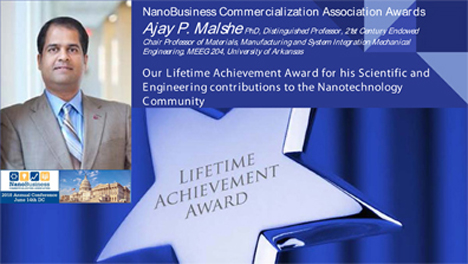
Malshe Elected to National Academy of Engineering
University of Arkansas

White House to unveil $1.5 trillion infrastructure plan
The Hill

EPA chief’s questions about climate science draw new scrutiny
The Hill

At least 1,000 gallons of oil spill into North Carolina river
New York Post

Unfiltered Fervor: The Rush to Get Off the Water Grid
The New York Times

The Download: SpaceX Disaster, AI With Uncertainty, and Trump Says the “B” Word
MIT Technology Review

EPA removes 7 cleaned-up sites from Superfund list
The Hill

Global Water Technologies releases annual shareholder letter
GWT News

Vincent Caprio to serve as consultant for Pfeiffer University Center for Digital Transformation
Pfeiffer University

—————————————————————————
I am really excited to continue our Water 2.0 series with Pfeiffer University in 2018.  Click here to see completed Water 2.0 events.  Looking forward to seeing you in Raleigh-Durham on May 17th!

COFES Institute Announces George Gilder as a Keynote at COFES 2018

Posted on February 16th, 2018 in Uncategorized | No Comments »

COFES Institute Announces George Gilder as a Keynote at COFES 2018

The COFES Institute is pleased to announce venture capitalist and best-selling author, George Gilder, as a keynote speaker at COFES 2018 in Scottsdale, ArizonaApril 12-15, 2018 at the Scottsdale Plaza Resort. Mr. Gilder will be a featured keynote speaker on Saturday.

This year at COFES 2018, the theme will be Human-Aided Design: Changing the Relationship between Our Tools and Us. To request an invitation, visit apply.cofes.com. The annual four-day event for the design and engineering software industry brings together a diverse group of thought leaders in technology and science to engage in wide-ranging and meaningful discussions.

At COFES 2018, Mr. Gilder will be speaking about his forthcoming book, Life After Google, which is due to be published in 2018. The new book examines and discusses the coming profound shift in the global technological and business landscape being ushered in by blockchainand other emerging technologies.

“Mr. Gilder is an accomplished best-selling author and futurist,” said Vincent Caprio, COFES Institute President. “Gilder will challenge COFES attendees with new ideas and their application to the engineering software arena.”

“One of the key roles I have relished over the past 18 years was the opportunity to find and work with great keynoters for COFES,” said Brad Holz, co-founder of COFES, president and CEO of Cyon Research Corporation. “We look for folks who are way ahead of the curve, with ideas of significance, and who really want to engage with us. I’m delighted that the COFES Institute has been able to continue that tradition with George Gilder. While I may take personal issue with some of the positions he has taken on social issues in the past, he is indisputably a leading thinker on technology issues and I look forward to his latest work.”

About George Gilder
Mr. George Gilder is Chairman of Gilder Publishing LLC, in Great Barrington, Massachusetts, and a founder-fellow of the Discovery Institute in Seattle. He is the author of twenty books on economics and technology including, Wealth and Poverty (1981), The Spirit of Enterprise (1986), Microcosm (1989), Life After Television (1990), Telecosm (2000), The Silicon Eye (2005), and The Israel Test (2009).

In the past decade, Gilder has begun revolutionizing the field of economics. In his book, Knowledge and Power (2013), Gilder presents a new economy based on the information theory that enabled the computer revolution and the rise of the Internet. In a review, Steve Forbes stated that the book “will profoundly and positively reshape economics… (and) will rank as one of the most influential works of our era.” The book won the Leonard E. Read prize at FreedomFest in Las Vegas in 2013.

In his latest book, The Scandal of Money (2016), Gilder extends the economics of information theory into a prescription for overcoming worldwide disorders of money with new crypto-currencies linked to gold. James Grant, publisher of “Grant’s Interest Rate Observer,” stated that the book “will outlast the Federal Reserve.” Silicon Valley venture capitalist Peter Thiel declared “he is our best guide to our most fundamental economic problem.”

Mr. Gilder is a contributing editor of Forbes magazine and a contributor to such publications as the Forbes, Harvard Business Review, The Wall Street Journal, and other publications. He lives in Tyringham, Massachusetts, in the Berkshire Mountains, where he is an active churchman, runner/cross country skier, and with his wife Nini, parent of four children.

About COFES and the COFES Institute
Now in its 19th year, COFES is the annual, invitation-only event for the design and engineering software industry. Widely recognized as a think-tank event, COFES (cofes.com) gathers design and engineering software leaders (vendors, users, press, and analysts) together to discuss the role engineering technology will play in the future survival and success of business. COFES is renowned for hosting leading keynote visionaries that provide a new perspective to the future of the industry. Apply for an invitation at apply.cofes.com.

The COFES Institute was created in 2017 to provide sustainable leadership to COFES. The COFES Institute is a non-profit 501c3 governed by a Board of Directors led by Vincent Caprio. Other members of the board are (in order of last name): Jim Brown: President – TechClarity, Jim Doxey: Product Configuration Manager – Oculus, Nathanael Miller: Aerospace Engineer – NASA Langley Research Center, Jason Preston: Co-Founder – Parnassus Group (DENT), and Rebecca Yeh: Event Director & Secretary – COFES. In addition, the COFES Advisory Board was established to provide industry input to the COFES Board, see the COFES website for a listing of the Advisory Board participants.

Vincent Caprio to serve as consultant for Pfeiffer University Center for Digital Transformation

Posted on February 6th, 2018 in Uncategorized | No Comments »

Vincent Caprio to serve as consultant for Pfeiffer University Center for Digital Transformation

Pfeiffer University’s Center for Digital Transformation (CDT) has hired a new consultant to expand the university’s impact in the energy and water industries.

Vincent Caprio, Director and Founder of the Water Innovations Alliance Foundation, will provide Pfeiffer’s CDT with the insight and connections necessary to identify technology-based solution opportunities in these exciting fields.

“Vincent is exceptionally well-versed in a broad spectrum of emerging technologies that impact our country’s energy and water infrastructure,” said Dr. Ken Russell, Pfeiffer Vice President for Digital Transformation and CDT Director. “He understands the dynamic role technology can play in solving current problems as well as how market-driven technology solutions can provide keen insight into future trends.”

Caprio, who Keynoted at the Water 2.0 Conference held at Pfeiffer in September and will be presenting at the upcoming conference in Raleigh on May 17th, has produced 20 Water 2.0 conferences during the last 10 years. Caprio has been a noted speaker at numerous emerging technology conferences throughout America over the past two decades. He has testified before the EPA and OSTP and has contributed to several business publications dedicated to bringing effective solutions to the municipal water industry in order to help utilities work smarter and upgrade systems efficiently.

“I am thrilled to become part Pfeiffer’s CDT team and to collaborate on finding innovative solutions to difficult challenges,” said Caprio.

“Having been an association leader for years in both the water and energy sectors, I know the challenges facing the nation’s water infrastructure are extremely difficult and these sectors will greatly benefit from CDT’s strategy to promote a practical approach to solving such complex technology problems.”

The Center for Digital Transformation promotes a practical approach to solving complex technology problems. CDT is focused on building strong partnerships and providing applied and experiential learning opportunities for students while transforming the way the educational experience is developed, packaged, delivered and supported.

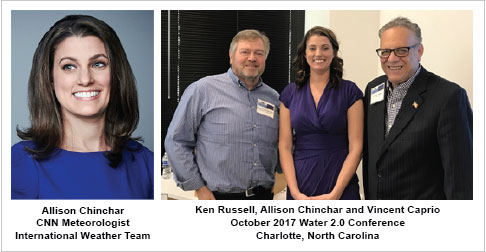
(Pictured from left to right, Dr Ken Russell, Vice President for Digital Transformation, Pfeiffer University; Allison Chinchar, Meteorologist, CNN and Vincent Caprio, Director and Founder of the Water Innovations Alliance Foundation.)

COFES Institute Interview with Joel Orr, Co-Founder of COFES

Posted on January 18th, 2018 in Uncategorized | No Comments »


COFES Institute Interview with Joel Orr, Co-Founder of COFES
January 2018

Today we are proud to share our third COFES Institute newsletter, with our interview of Joel Orr, Co-Founder of COFES.

Steve Waite: It is wonderful to speak with you today, Joel. Tell us about the genesis of COFES and what you were hoping to achieve with the event as a co-founder.

Joel Orr: We were driving to the airport after the NDES show – the National Design Engineering Show – in 1999. We all noticed the same thing at the show. All the interesting conversations happened in the hallways. So we decided to try to create an event that would be mostly hallways. The back room discussions, so to speak, became front and center. That was our genesis and that is what we have attempted to achieve with COFES.

SW: Excellent! You have a long, distinguished career in CAD. Take us back to the early days and tell us what you saw.

JO: I got into the technology of CAD at my last W-2 job. I was Systems Manager for the computer department of Nashville, Tennessee. I was in charge of creating one of the first municipal geographic information systems in 1973. From there, I became a consultant and did similar projects in various cities in the US, as well as in Israel.

There was an emerging trend where companies were investing more money into electronic, mechanical and architectural design than they were putting into mapping. Because of my familiarity with the technologies, I took a role in more general CAD while staying involved in mapping. That gave me a very broad kind of outlook.  I’m a techno-dilettante. That is someone who is an inch deep and a mile wide in all of these areas.

SW:
What was a conventional CAD system like back in the 1970s?

JO: CAD systems in the ‘70s were something that cost in the neighborhood of $100,000 per seat, at a time when a senior engineer was making $20,000 per year.  Before purchasing a system like that, companies wanted to get some assurance that if they bought one, they wouldn’t be sorry. Paying a consultant $5,000 to spend some time helping them understand the nature of their issues and what might be useful was a good deal for them. Everything evolved from there.

SW: What were the key factors in evaluating whether a CAD system made sense for a company back in the 70s?

JO: Most issues in large companies are people issues, not technology issues. Early on in the game, people were dazzled by the technology. It seemed magical. There was no way it could fail. I would bring a little bit of a wet blanket to the promises of the CAD sales people and teach my clients about the right questions to ask and who to ask them of.  Every CAD vendor had some success stories. Early on, I realized that most benchmarks are staged affairs. I focused on interviewing CAD users to get around the staging issue.

SW: That is interesting. I was part of a team with Gideon Gartner and one of his protégés that did something similar back in the early 2000s. I didn’t realize you were a pioneer in this area. Where did interviewing CAD users take you? What kind of opportunities emerged from that approach?

JO: That work with users led to consulting with CAD vendors. My contacts with the clients were useful to the vendors. I had established a reputation as an independent consultant that could not be bought.  They would bring me in to educate the client in general or for discussion. That became a good part of my business as well.  I worked with both users and vendors.

SW: So you developed a model that allowed you to work with both CAD users and vendors without any conflicts of interest. Is that a correct statement?

JO: Yes it is.

SW: That is an admirable business model. From your grand perspective of collaborating closely with both users and vendors, what is the primary value add of a CAD system?

JO: The essence of the engineering is that it is a non-deterministic process. That is, having a set of initial conditions, you cannot accurately predict the final conditions. The dynamic that drives this process is trial and error.  You try something. You tweak it and fiddle with it. You hope that your fiddling converges – that it gets closer to the ideal. That in and of itself is not guaranteed either. The essence of CAD is to build models more quickly and more precisely than you can in any other way. That is how CAD happened.

SW: So the primary value of CAD is speed and precision within an engineering process that is non-deterministic.

JO: Yes, that is correct. And there is another important element. With CAD, mistakes are cheap.

SW: Ahhh… it is easy to see the incredible value CAD brings to the table: Speed, precision and cheap mistakes.

JO: Yes. There was a time before CAD when getting the precise volume of something like a shampoo bottle was not a trivial exercise. It involved wooden models, creating a plastic mock up, and measuring the amount of liquid that could go in it. CAD was able to do this. You could specify by volume rather than having to experiment with physical models. CAD transformed the entire container industry.

SW: Let’s fast forward to today. We’ve seen remarkable advances in technology hardware and software since the early 70s. We can do trial and error faster and more precise than ever. Engineers are using CAD systems today to design products at the nanometer level. What’s your perspective on CAD today?

JO: We are designing semiconductors with circuitry so intricate and tiny that the human eye cannot see it. CAD enables this type of nano-engineering. This is all moving into the world of medicine. We are 3D printing kidneys today. You have to be able to manipulate very, very small things – things you cannot see.

SW: The designs and engineering enabled by CAD systems today are truly astonishing, bordering on science fiction in some cases. What kind of CAD-enabled future do you foresee based on current technological trends?

JO: In the mid-70s, my IBM salesman was my best friend. He said that IBM Labs had developed a simulation system that could predict the outcome of the World Series based on various data inputs. He said there was only one thing wrong with the system. It took three weeks to make the prediction. We know that the World Series doesn’t take three weeks to play, so that was a big problem. The fact that you can predict the outcome of an event like the World Series a week or two after the outcome wasn’t valuable.

SW: Things have sped up quite a bit since then!

JO: Yes, they have. Think about knowing what the outcome of the World Series is before it is over. We have computer systems today with that kind of power. That’s a game-changer. (Although I haven’t seen any World Series prediction systems that work yet, so the salesman may have been a bit over-confident…)

SW: That boggles the mind. What’s the role of the human designer and engineer in tomorrow’s CAD world – a world that is likely to be increasingly populated with AI, machine learning, virtual reality and other emerging technologies?

JO: That’s a good question. The way a friend of mine put it, there is no question that real AI is coming. But the real question is whether it will like us and keep us around.

SW: Well, that is a provocative statement and one that is likely to generate a great deal of discussion. Let’s table any further discussion for the upcoming COFES event. We’ll be talking a lot about human-aided design in a world of AI. Suffice it to say, the upcoming COFES event promises to be another great one!

JO: Yes, it does.

SW: It has been wonderful speaking with you today, Joel. Thank you for your time. We hope to see you at COFES 2018.

Steve Waite is a member of the COFES Institute Advisory Board. He is the author of several books, including Quantum Investing and Venture Investing in Science.


——————————
If you are interested in participating in COFES 2018, then please contact Vincent Caprio, President of COFES Institute vincent@cofes.org

Happy Holidays from NanoBCA!

Posted on December 21st, 2017 in Uncategorized | No Comments »