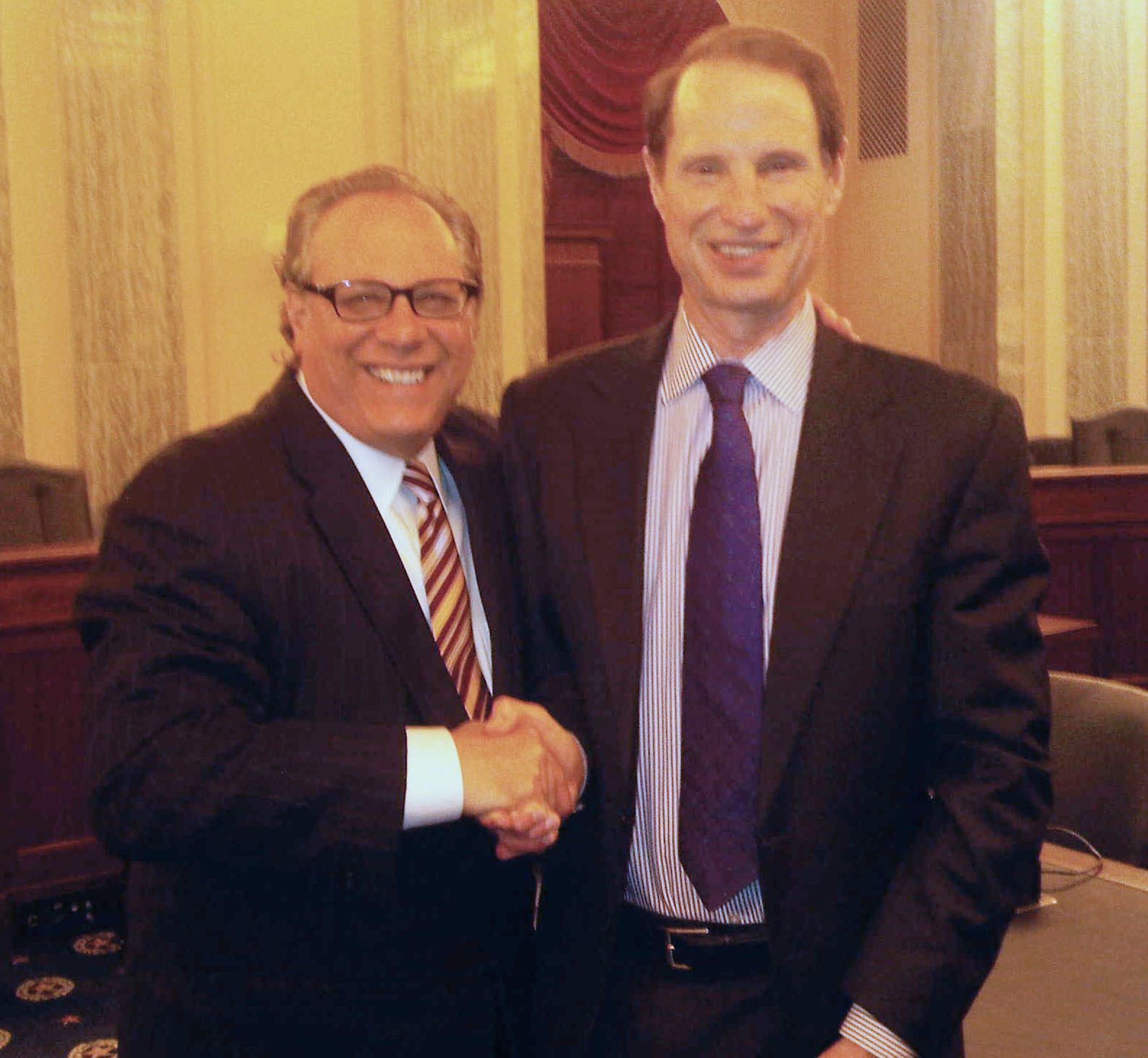
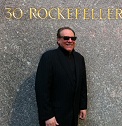
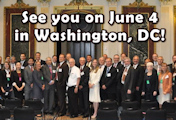
Vincent Caprio & Senator Ron Wyden at the 2011 Nano Caucus on Wednesday, June 22nd
On June 22, 2011, the Congressional Nanotechnology Caucus convened its first meeting in 2011 and hosted its inaugural Nanotechnology Caucus Lecture: Nanotechnology 101. The Nanotechnology Caucus is a bipartisan group of Members dedicated to promoting nanotechnology. Opening remarks were provided by Vincent Caprio, Executive Director, NanoBusiness Commercialization Association. Attendees were then treated to extensive remarks by Senator Ron Wyden (D-OR), a tireless champion of nanotechnology.
Sally Tinkle, Ph.D., Acting Director, National Nanotechnology Coordination Office, Nanoscale Science, Engineering, and Technology Subcommittee, Committee on Technology National Science and Technology Council, provided an excellent overview of the National Nanotechnology Initiative, and focused on some of the many commercial successes of nanotechnology commercialization and the many ways these products are improving energy consumption, medical care and treatment, greener chemistry, and providing other benefits.
Jim Hussey, Chief Executive Officer, Nanoink, Inc., gave a spirited presentation on some of the commercial challenges facing the nano community and the need for universities, investors, and other nano stakeholders to stimulate investment in nanotechnology.
Travis Earles, Ph.D., Advanced Materials and Nanotechnology Initiatives, Lockheed Martin Corporation, and former Assistant Director of Nanotechnology, White House Office of Science and Technology Policy, shared his insights as a former policymaker and his transition to the private sector.
Finally, Frank A. Ignazzitto, Vice President, Government Business, QD Vision, Inc., explained how QD Vision’s commercialization of quantum dot technology will greatly conserve energy and enhance significantly the resolution of screens in consumer and related electronics, among other benefits.
I am very happy to announce the Nano Caucus returns!
The Nanotechnology Caucus Lecture: Nanotechnology 101, will take place on Wednesday, June 22, 2011, at 11:00 a.m. in Room 253 of the Russell Senate Building.
AGENDA
11:00-11:05 Opening Remarks: Vincent Caprio, Executive Director, NanoBusiness Commercialization Association www.nanobca.org
11:20-11:40 Sally Tinkle, Ph.D., Acting Director, National Nanotechnology Coordination Office, Nanoscale Science, Engineering, and Technology Subcommittee, Committee on Technology National Science and Technology Council, Arlington, VA http://nano.gov/
11:40-12:00 Travis Earles, Ph.D. (Invited), Advanced Materials and Nanotechnology Initiatives, Lockheed Martin Corporation Bethesda, MD (formerly Assistant Director of Nanotechnology, White House Office of Science and Technology Policy)
12:00-12:20 Jim Hussey, Chief Executive Officer, NanoInk
“Moving from lab to marketplace: what nanotechnology needs” http://www.nanoink.net/
12:20-12:40 Frank Ignazzitto, Vice President, Government Business, QD Vision, Inc., Watertown, MA http://www.qdvision.com/
Vincent Caprio “Serving the Nanotechnology Community for Over a Decade”
Executive Director
NanoBusiness Commercialization Association 203-733-1949 vincent@nanobca.org www.nanobca.org
I would like to share with the Nanotechnology Community regulatory developments that occurred last week in Washington, DC on Thursday, June 9th. Paul Stimers, Partner, K&L Gates and NanoBusiness Public Policy Advisor stated the following.
Thursday, June 9, 2011 was a busy day for federal nanotechnology policy, with action from two regulatory agencies and the White House on the environmental, health, and safety aspects of nanotechnology. The NanoBusiness Commercialization Association continues to call for more research on this front, so that any regulatory activity addresses real needs, avoids unnecessary burdens on small businesses, and enables safe and useful products to reach the market.
EPA announced plans to gather information on nanomaterials in pesticide products to determine “whether the registration of a pesticide may cause unreasonable adverse effects on the environment and human health.” The agency plans to gather information both by requiring pesticide registrants to inform EPA of new information “regarding unreasonable adverse effects on the environment” and through data call-in notices. EPA also will propose a new case-by-case approach for determining “whether a nanoscale ingredient is a ‘new’ active or inert ingredient for purposes of scientific evaluation under the pesticide laws, when an identical, non-nanoscale form of the nanoscale ingredient is already registered under the pesticide law.” The full prepublication notice, including instructions for commenting, is available at http://www.epa.gov/pesticides/regulating/prepub-nanopest.pdf.
FDA issued draft guidance for industry that describes the agency’s “current thinking on whether FDA-regulated projects contain nanomaterials or otherwise involve the application of nanotechnology.” It represents a more expansive approach than has been taken in the past by the NNI and industry. FDA stated that its two key criteria in answering that question will be:
1) Whether an engineered material or end product has at least one dimension in the nanoscale range (approximately 1 nm to 100 nm);
or
2) Whether an engineered material or end product exhibits properties or phenomena, including physical or chemical properties or biological effects, that are attributable to its dimension(s), even if these dimensions fall outside the nanoscale range, up to one micrometer.
Importantly, FDA noted that “these considerations apply not only to new products, but also may apply when manufacturing changes alter the dimensions, properties, or effects of an FDA-regulated product or any of its components.” FDA also indicated that the criteria are subject to change in the future as more data becomes available. The full document, including instructions for submitting comments within 60 days, is available at http://www.fda.gov/RegulatoryInformation/Guidances/ucm257698.htm.
The White House also issued a joint memorandum on the regulation of nanotechnology from the Office of Science and Technology Policy, the Office of Management and Budget’s Office of Information and Regulatory Affairs, and the office of the U.S. Trade Representative. The memo provides guidance to agency heads, stating that “regulators should use flexible, adaptive, and evidence-based approaches that avoid, wherever possible, hindering innovation and trade while fulfilling the federal government’s responsibility to protect public health and the environment.” The memo lists principles that agencies should follow. It is available at http://www.whitehouse.gov/sites/default/files/omb/inforeg/for-agencies/nanotechnology-regulation-and-oversight-principles.pdf.
This message is for informational purposes and does not contain or convey legal advice. The information herein should not be used or relied upon in regard to any particular facts or circumstances without first consulting a lawyer.
These recent regulatory developments, discussed by Paul will, have an impact on our Nanotechnology Community. I would be happy to answer any questions in regard to these recent regulatory developments.
Regards,
Vincent Caprio “Serving the Nanotechnology Community for Over a Decade”
Executive Director
NanoBusiness Commercialization Association 203-733-1949 vincent@nanobca.org www.nanobca.org
As spring leads into summer the Nanotechnology Community is buzzing with good news. On June 1st, Solazyme http://www.solazyme.com/ announced their IPO.
Publicly Traded Nanotechnology Companies – Stock Results
(see attached spreadsheet)
ARPA-E energy leader to meet with NanoMech
NanoMech lubricants provide manufacturing competitiveness and decrease America’s dependency on foreign oil http://classic.cnbc.com/id/43308105
Vincent Caprio “Serving the Nanotechnology Community for Over a Decade”
Executive Director
NanoBusiness Commercialization Association 203-733-1949 vincent@nanobca.org www.nanobca.org
NanoBCA Publicly Traded Nanotech Stocks – May 2011 Update
In this month’s interview, we talk to Jess Jankowski, President and Chief Executive Officer, and a Board Director of Nanophase. Mr. Jankowski was elected Chief Executive Officer (Acting) in August of 2008 and was elected President and Chief Executive Officer, and Board Director, in February 2009. He joined Nanophase in November 1995. He was elected Secretary and Treasurer in November 1999, Acting Chief Financial Officer in January 2000, Vice President in April 2002, and Vice President of Finance and Chief Financial Officer in April 2004. From 1990-1995 he served as Controller for two building contractors in the Chicago area, during which time he had significant business development responsibilities. From 1986 to 1990 he worked for Kemper Financial Services. Mr. Jankowski holds a B.S. from Northern Illinois University and an M.B.A. from Loyola University. He was elected to the TechAmerica (formerly AeA) Midwest Board in 2008 and was an active member of the TechAmerica Midwest CFO Committee from 2006 through 2008. He was appointed to the NanoBusiness Advisory Board in 2009. Mr. Jankowski was appointed to the Romeoville Economic Development Commission in 2004 and served in 2010. He has also served on the Advisory Board of NITECH (Formerly WESTEC), an Illinois Technology Enterprise Center focusing on the commercialization of advanced manufacturing technologies from 2003 to 2008. In 2009, Mr. Jankowski was appointed to the Board of Directors of the Northern Illinois Technology Foundation, an economic development and technology transfer entity that is part of Northern Illinois University.
In our interview, we discuss the current state and outlook for innovative nanomaterials. We hope you enjoy the interview with Jess Jankowski. -Steve Waite, Director of Research and Strategy, The NanoBusiness Commercialization Association
SW: Thanks for taking the time to speak with us, Jess. Nanophase has been in business for quite some time. Give us a little background of how the company got started, how it has evolved, and what its mission is today.
JJ: Nanophase is built from an idea that grew out of the Argonne National Laboratory – the ability to make pure metal oxide particles for particular applications at the nano scale. Often, manufacturers are forced to use materials with impurities or with secondary structures that don’t provide the effectiveness they are looking for. With this technology, we can provide metal oxides to manufacturers in any form (dry powder, dispersed in liquid, or dispersed into a plastic flake that is ready to use in their process) with the desired attributes ranging from particle size and shape to particular surface chemistries. It was a better way to provide manufacturers with materials they needed.
SW: What are the primary nanomaterials produced by Nanophase and why is the company focused on those materials?
JJ: The most popular is nano zinc oxide used in personal care applications (such as sunscreens for sensitive skin). Zinc oxide is an excellent, all natural, full spectrum UV ray absorber. Using nano zinc oxide allows that glob of white cream that we used to see decorating so many lifeguard’s noses to be clear today. Zinc oxide is gentler on the skin than many of the organic chemicals used to achieve the same purpose, so we have noticed an uptick in use in both sensitive skin sunscreen applications as well as certain daily wear cosmetics. Our material is also considered an “all-natural” or mineral-based product, which resonates with quality conscious consumers. Just as zinc oxide protects human skin, it also is effective in certain UV protection applications such as for exterior coatings (paints and stains) and many other applications.
Beyond zinc oxide, we have developed a family of aluminum oxide additives to impart a thin layer of scratch resistance to high-end packaging, signage, and consumer electronics products. We also use cerium oxide for polishing applications, from semiconductor and other electronics applications through architectural window solutions. We typically sell chemical additives, but our polishing expertise allowed us to launch our first complete product line for window polishing and restoration under the NanoUltra™ family of products. These are the most common products we sell, but we also sell smaller amounts of several other metal oxides for particular applications. We have a very flexible manufacturing platform that allows us to pursue markets broadly.
SW: There are numerous applications for nanomaterials in the 21st century. Tell us about the applications Nanophase is currently targeting in the market.
JJ: Several areas where we see significant opportunities in the near term are natural UV protection in personal care (e.g., sunscreens and daily wear cosmetics), providing scratch resistance in transparent coatings, UV-resistance in architectural coatings and a series of other applications that are too early-stage to mention. We fully understand that we will increase and decrease our focus in various markets as we grow and gain more commercial feedback. The underlying need for both transparent functional coatings and well-dispersed active materials provides us with more opportunities than we can possibly address simultaneously. For now, focus is the key!
SW: What are the major advantages to a sunscreen product that is produced with your nanomaterials?
JJ: Our nano zinc oxide provides a terrific combination of being very effective while gentle. Unlike many solutions on the market, nano zinc oxide is a full spectrum UV blocker, meaning that it minimizes the effects of UVA and UVB radiation very well. Many products have historically focused on UVB for blocking sunburn, without paying as much attention to UVA, which relates to cellular degradation and skin cancer. New label requirements in Europe, and likely soon to be in the United States (maybe this year), will require this be better disclosed, and you’ve likely already seen products on the shelves that are dealing with these disclosures. Sunscreens with our materials are designed to be long lasting, even when used in water. And zinc oxide tends to be gentle on the skin, more so than many of the organic chemicals commonly used. These reasons explain why our products are often found in sensitive skin products, and also explain why we are a natural choice for daily wear cosmetics.
SW: Please tell us more about the transparent UV resistant coatings for wood that Nanophase is developing. What are its advantages relative to existing products on the market?
JJ: The most effective wood coatings today tend to rely on heavy pigments to achieve UV protection, so that the wood will often look red or orange depending on the pigment being used. There’s nothing wrong with those colors, but many would prefer the natural look of their wood and simply want it to last longer. We have seen that our nanomaterials can improve the effectiveness of coatings significantly, particularly in the transparent and lighter-pigmented semi-transparent applications. We are working with customers to take the basic technology to market in both semi-transparent and completely transparent wood coatings. This is an area where we hold a significant advantage over the tradeoffs that historically had to be made – protection vs. transparency. Our solutions offer the market both.
SW: What are some of the futuristic nanomaterials applications Nanophase is working on that you can share with us?
JJ: Working at a small scale with significant control over the particles has provided potentially huge energy applications that we are working on, although it will take some time to determine viability. Very thin, transparent coatings also present strong potential advantages in plastics applications. We have recently devised a method for adding our materials into several traditional plastics fabrication processes, and are working with alpha customers on different applications. Either of these concept areas could launch a company today, but we are looking at them as additional areas for the strategic growth of our company, which already has a good history and understanding in creating and then manufacturing these solutions.
SW: Do you sense there is a misconception today among policymakers, companies, and the general public about nanomaterials?
JJ: The unknown is inherently scary. People who don’t know what we do often assume that we are making little robots that will take over the world, or unstoppable microbes. What we are really doing is improving the forms, or formats, of materials that have been used for a very long time. The data we see supports the safety of our products, and we believe we meet every available standard of safety in our manufacturing processes. I can only address our products – many companies are creating products at a nano scale for all sorts of applications today that I’m less familiar with, and I’m sure some will have issues and others won’t, just like any other business segment. I believe we’re seeing a softening of this paranoia in the marketplace and in legislative circles.
SW: What kind of testing has Nanophase been involved with over the past decade – either directly or indirectly – with its nanomaterials and what are the results of those tests?
JJ: This is a broad topic that I won’t try to address completely. I think the best way might be to discuss how we at Nanophase handle our Environmental Health and Safety (“EH&S”) program. Given that there aren’t specific rules regarding the evaluation of nanomaterials in the workplace, we have adopted and enhanced the existing safety regimes commonly and effectively used in the chemical industry. We rely on NIOSH and OSHA standards as the starting point for our EH&S program. To their requirements (compliance to chemical exposure rules and Permissible Exposure Limits or “PEL”), we have added a combination of additional tools and techniques to assess, control and monitor exposure to nanomaterials in the workplace. We measure fugitive emissions regularly and, in most cases, measured particulate levels are between one 1% and 5% of the established “PEL” by OSHA. Keep in mind that this standard includes both total and respirable dust. Many of the minimal particulates counted are generated by non-production (meaning, non-nanomaterial) processes. Our results also regularly show that the particle counts inside the production areas are measured lower than the particles present in the outdoor environment, including in the parking lot of the fast food restaurant down the street!
Lastly, on an annual basis, Nanophase executes a facility wide medical evaluation for production, quality, engineering, and R&D employees. The evaluation consists of a medical questionnaire, a pulmonary function test, and a follow-up physical if a need is determined by the company’s physician. The purpose of this evaluation is to monitor and respond to any decline in pulmonary function and to check for any other medical condition related to a single employee or pool of employees. Over the past five years (where our date is readily available), not a single employee has shown a decline in their medical condition that can be related to workplace exposure. I’m proud of our record, I’m proud of our EH&S team, and we continue to focus on strengthening our program whenever we determine additions can be helpful.
SW: Outside of the United States, what other countries are heavily engaged in nanomaterials research and development and how much innovation are we seeing in those countries?
JJ: This is a significant area of concern. The United States has enjoyed being a technology leader for decades. This is changing. Education and employment opportunities outside the United States have been improving at a much faster clip than domestically. Nanotechnology remains largely a “basic science” application, and fewer people are willing to put money behind learning about how things work. This is likely going to get far more imbalanced over time, as other nations promote technologies that will enable the next generation of products, while we struggle with fiscal challenges. While we often compete against non-nano technologies, we see that our most direct competitors are already located outside the United States.
SW: One last question for you, Jess. China moved to restrict its exports of “Rare Earth” minerals. What kind of impact do you think this will have on the nanomaterials business in the future?
JJ: We vaporize metal, so commodities are our raw materials. “Rare Earths” are a classification of materials often used in high end electronics. One member of that class is the cerium oxide we sell for polishing applications. As 97% of Rare Earth materials are exported from China today, the severe export restrictions imposed during 2010 are having a dramatic impact on the market. Many companies can’t get the material they need, and those which have been able to do so, like Nanophase, must pay significantly more than they did a year ago. This hurts our customers, and over time will drive changes in methods and products. We are working very closely with our customers on managing these issues, but they are significant. Our investment in inventory has skyrocketed because our customers need this material. New sources of supply are opening around the world during 2011, 2012, and beyond, but this will remain a significant challenge to many high-tech industries for the foreseeable future.
There are two mitigating bright spots here:
1) Cerium oxide to allow results to be achieved that are not possible with other materials today, so demand will continue to some extent; and
2) Smaller materials achieve greater functionality “per pound” than larger materials and, therefore, inherently require smaller quantities of materials to achieve a given performance level. This reduces both cost and, ultimately, offers greener alternatives in some cases where fewer byproducts are created for a given process.
SW: Thanks again for your time, Jess. It has been a pleasure speaking with you. We wish you and your colleagues at Nanophase all the best in the future.
You will be able to hear Jess live and in person at our 10th Annual Event.
PLEASE SAVE THE DATE for our 10th Annual NanoBusiness Conference/Nanomanufacturing Summit 2011
September 25-27, 2011
Boston, MA http://www.internano.org/nms2011/
REGISTER TODAY
Industry/Government:
$400.00; $500.00 after August 26, 2011
Vincent Caprio “Serving the Nanotechnology Community for Over a Decade”
Executive Director
NanoBusiness Commercialization Association 203-733-1949 vincent@nanobca.org www.nanobca.org
NANO NEWS – Spring Edition Volume 2
This spring has brought us many exciting new developments in our Nanotechnology Community. We would like to share with you the following articles:
50 years ago on May 25, 1961, President John F. Kennedy announced the U.S. goal of sending an American safely to the Moon before the end of the 60s. http://history.nasa.gov/moondec.html
Vincent Caprio “Serving the Nanotechnology Community for Over a Decade”
Executive Director
NanoBusiness Commercialization Association 203-733-1949 vincent@nanobca.org www.nanobca.org
Attached is a fantastic article that was published in the May 2nd edition of Chemical Engineering News entitled U.S. Nanotech at a Crossroads by Britt E. Erickson. NNI Hearing Article – CEN
Vincent Caprio “Serving the Nanotechnology Community for Over a Decade”
Executive Director
NanoBusiness Commercialization Association
203-733-1949 vincent@nanobca.org www.nanobca.org
In this month’s interview, we talk to Dr. J. Steven Rutt, Partner and Chairman of the Nanotechnology Industry Team at Foley & Lardner LLP. Dr Rutt’s practice includes patent counseling, patent prosecution, IP licensing and agreements, including technology transfer carried out under the Bayh-Dole Act, patent landscaping and clearance opinions, due diligence, patent litigation support, trade secrets, and trademarks. Dr. Rutt is a frequent writer and conference presenter with respect to nanotechnology and the law, actively helping to lead and participate in Foley’s Nanotechnology Industry Team. Currently, he is editor of the blog, www.nanocleantechblog.com. He is also the author of a dozen scientific publications and inventor on four patents. His experience includes nine years of hands-on research in polymer synthesis and morphological studies, and his experience in private industry includes two years of corporate chemical research with NTT in Tokyo, Japan. Dr. Rutt’s legal papers have been published widely, including publications such as Nanotechnology Law and Business Journal, Journal of the Patent & Trademark Office Society, The SciTech Lawyer, and the Legal Times.
Dr. Rutt received his law degree from Georgetown University Law Center, his doctorate in chemistry from The Pennsylvania State University, and his bachelor’s degree in chemistry from Goshen College.
In our interview, we discuss intellectual property, the current regulatory environment for nanotech, what kinds of services are in demand currently by the nanotech community, as well as the upcoming Supreme Court case on Bayh-Dole and what the implications might be for the nanotech community. We hope you enjoy the interview with Steven Rutt. – Steve Waite, Director of Research and Strategy, NanoBCA
SW: It’s great to speak with you today, Steve. I would like to begin by having you give us an overview of the nanotech practice at Foley & Lardner (F&L) and tell us about the role you play in the nanotech community.
SR: Foley and nanotech go back a long way. A relatively young, astute Foley lawyer identified nanotech and the NNI early on as an important driver for the future. The firm agreed, rapidly organized a nanotech team, and positioned itself ahead of many other firms. Later, other firms jumped in when nanotech became a buzz. Foley is a relatively large, general practice firm of almost 1,000 lawyers, so the innovative spirit is also coupled with strength and stability. The firm provides closely networked experts in different legal fields including intellectual property, regulatory, corporate, and litigation.
Over the years, we have done many things: sponsored and supported nanotech conferences and organizations, taken part in working with the government and its agencies (including lobbying and the NNI), spoken to media, and participated in journals. All of this is so we are better situated to serve clients and keep pace with the many developments. We also work with regional accelerators as advisors. We have also tried to understand deeply the dynamics of things and how, for example, energy applications of nanotech morph into cleantech. For me, personally, I had a background in chemistry and materials science, so it was a natural fit for me to get involved with nanotech.
A recent example: we try to work closely with the U.S. Patent & Trademark Office (PTO) which is a short drive from our D.C. offices. Last December, we were at the NNI at Ten conference and met some of our contacts at the PTO. From that informal talk, we agreed to help the PTO organize a cleantech customer partnership meeting this April, including how nanotech has contributed to cleantech. So we try not to sit still.
SW: We are seeing nanotech R&D initiatives bear fruit in terms of product commercialization and job creation. What’s your sense of the support for nanotech-related research and business activity in Washington today, particularly with the changes in Congress we’ve seen recently?
SR: Surprisingly, some common ground exists between the two parties. Hopefully, nanotechnology can continue to be a bi-partisan effort, and we will experience thoughtful leadership rather than crass rancor. There tends to be more agreement in the view that we need to fund defense-related technology. Even DARPA promotes nanotech and cleantech. Also, funding of basic research is an area of common ground. Finding the next nanoscale switch for the electronics/computer industries is vital. Also, no one can deny energy is important when gasoline pump prices go sky high and political tensions erupt around the world. Manufacturing and nanomanufacturing are also common grounds.
The Obama Administration has quietly supported nanotech, including for example the recent $2.1 billion supplemental NNI budget request. Nanotech does not get as much press as cleantech from the Obama administration, but a critical chunk of cleantech is based on nanotech.
Clearly, a compelling policy debate is whether the United States should fund and promote more direct commercialization efforts as found in competing countries like China and Germany (so-called “picking winners and losers” in the marketplace). The two leading parties simply do not agree on this issue. ARPA-E may be the most vivid example of this. Also, if the government supports a loan, and a failure happens, the politics can get hot as accusations fly about government mismanagement (even though failure is inherent to innovation).
Unfortunately, many observers believe that the U.S. is now “falling behind” in vital areas like nanotech and cleantech. Action is needed to catch up, whether from the government or the private sector. If the private sector is not doing it, we should not be surprised if the government steps in, or is at least asked to step in, to fill the vacuum. Venture capital, for example, may be attracted for business reasons to fund social media innovation, but government can also help ensure that innovation in the physical and life sciences also occurs whether or not venture capital funds it.
SW: Intellectual property is clearly an important area for nanotech. What kinds of activity and trends are we seeing in nano-related IP today?
SR: For IP, three lead topics include obtaining patents, licensing patents, and litigating patents. We monitor each week the patents and patent publications emerging which are classified as 977 nanotechnology patents. We are now approaching 7,000 class 977 patents, and more importantly, we have now over 8,000 published nanotech patent applications. We monitor these patents to get a feel for the trends and the types of language used in the claims. Many of these patents relate to electronics and semiconductors. For instance, companies like Samsung are filing in large volume. Unfortunately, fewer patents relate to pharma and biotech which is due to how the USPTO defines the classification. One must go outside of 977 to monitor nanobio; 977 is just a starting point. I have been impressed by the broad, balanced diversity of patent applicants populating 977, ranging from the Samsungs to the lone inventors, from the universities to the mid-sized companies, and from the government labs to the VC-backed start-ups.
Nanotech patent licensing and litigation are alive and well, from our experience. Universities and federal laboratories continue to aggressively market their patent licensing, and will face increasing pressure in coming years to show the government how the government funding for research is translating into jobs. Many companies, of course, want to avoid litigation, but if your product is valuable, competitors will arise, and IP disputes are almost unavoidable at some point – there are so many patents out there. Smart, well-managed companies aggressively manage the risks from the very start, searching for and formulating strategy for competitive patents. Some companies appear to just want to posture, and litigation can’t always be avoided.
New things seem to constantly come up. For example, we monitor deep shale gas drilling patenting and innovation, including Marcellus shale, which will have a profound impact. Now, nanotech patents are starting to appear in this innovation space. Graphene? Metamaterials? Always something new!
SW: You mentioned four areas of focus at F&L – Litigation, Corporate, Intellectual Property (IP) and Regulatory. Let’s discuss regulatory briefly. Generally speaking, how does the current regulatory environment for nanotech look from your perspective? What are the hot topics for nanotech at the EPA and FDA today, for example?
SR: Much has been written about nanotech and EHS, of course – perhaps too much? It seems as if more has been written than actually done. Innovation tends to flow faster than and not wait for regulation. The current climate for budget cutting and promotion of jobs tends to cool the fervor to regulate.
One topic that should receive more attention than it does is connecting innovation and regulation. It can come in several flavors. For example, one form is innovation to facilitate nanotech regulation. If you want to regulate exposure to nanoparticles, how do you measure the exposure? Is there a way to study nanomaterial toxicity without killing larger animals and minimizing animal rights concerns? Other EHS technologies actively do something remedial. As an example, the Department of Energy recently filed a patent application (2011/0039291) related to bioremediation of nanomaterials. EHS is best as an innovation growth area for the coming decade. Inventions can help with or be required for the kinds of regulation we want and make sense.
The EPA is perhaps the most active agency, and we have an active environmental regulation group which works with the EPA (e.g., Foley lawyers Sarah Slack, Dick Stoll, and Steven Chester). The EPA should be issuing TSCA nano-related rules in 2011 including reporting obligations for manufacturers. Another area of activity is regulation of certain public health claims about nanoscale products (e.g., “kill germs”). While we have an active FDA group (e.g., Foley lawyers, David Rosen and Nate Beaver), the FDA has been seemingly less active with nanotech in recent years. Some drug products and medical devices which incorporate nanoparticulate technology have been approved. In FDA’s discussion of looking ahead for the next five years, the FDA recognizes they need to become more involved, and keep abreast of new developments and emerging technologies like nanotech. As for OSHA, not much new for now, in the bigger picture.
One never knows when a crisis might occur to profoundly change the EHS debate. No one predicted too well the BP oil spill or the Japan nuclear crisis. In the meantime, we have slow evolution of regulatory dialog, tempered by the need to allow business to grow in a sluggish economy.
SW: With respect to the corporate services F&L provides, what types of services are most in demand today?
SR: It crosses the gamut. For example, new emerging tech companies, whether they are called nanotech or not, are always forming, expanding, and preparing to take it to the next level such as the next financing round, an IPO, or being bought. They need to be structured and financed through the changes. They need grant money. Employment matters come up. Stock options. Lobbying. IP. Complex agreement issues come up including supply agreements and technical advisory agreements are but some examples. Etc. Multi-disciplinary teams are essential. Finally, international issues are key including China. In particular, our corporate lawyers in such offices as Boston and Silicon Valley are active in these areas (e.g., Foley’s Jim Chapman, Susan Pravda, Julie Lee, Linda Ji, and Ken Duck).
SW: On your blog (http://www.nanocleantechblog.com/) you’ve written about the upcoming Supreme Court decision on Bayh-Dole. Give us some background on the case and tell us what the implications of a ruling in favor or rejection might be.
SR: Briefly, the case is Stanford v. Roche. Oral argument at the Supreme Court was held February 28, 2011, and a decision should issue shortly (sorry, I should avoid saying who will or should win). The fact that the Supreme Court agreed to take the case confirms the importance of IP, innovation, and government funding in the Court’s modern mindset. The Court could issue a broad, sweeping opinion or, more likely, issue a narrowly tailored opinion.
This is an important case because it touches on what can happen when federally funded research at the university is linked to private efforts for commercialization. The case interprets the Bayh-Dole Act, which is the legal regime set up thirty years ago to govern IP rights and licensing for federally funded inventions. These days, most agree that partnering is important for commercialization, and partnering includes individuals visiting other organizations to collaborate and learn. However, this can generate legal problems.
Here, for example, Stanford University fell into dispute with Roche over whether Roche needed to take a license on a Stanford patent. In essence, Roche said it obtained rights in the patent due to activities by a Stanford professor at Roche, and the nature of Stanford’s IP policies and assignments. Stanford says the Bayh-Dole Act preempts the Roche ownership claim.
I would guess the Court will rule narrowly, but they certainly have the option to provide extensive commentary about the complexities of modern innovation involving government funding and collaborations (“thought leadership” in addition to deciding the case).
SW: Your blog covers nanotech and cleantech. What role is nanotech playing today with respect to fostering innovation in cleantech?
SR: Many of the photo and electrical processes at the root of cleantech innovation are at the nanoscale. Examples include batteries, solar cells, and efficient lighting. Mitsubishi Chemical just announced a major initiative for organic solar cells, for example. The NNI has recently identified nanosolar as one of three signature areas to promote. Then there is nanoscale chemical engineering like filtration, passing water through the inside of nanotubes for example.
One particularly recent example was covered by CNN and caught my eye. It relates to rare earth metal magnets. These magnets are critical to defense and cleantech, but something like 97% of the supply comes from China. People also want to make stronger magnets, and ARPA-E has funded work in the area. Nanocrystalline powders turn out to be an important approach. Just recently, I learned one innovative company working in this area is actually located just a mile from where I grew up (which is a small, one red light town two hours away from the closest large city).
It is these sorts of remarkable stories which keep my interest in nanotechnology, including how nanotech continuously fuels cleantech, life sciences, and many other sectors. Nanotech perhaps does not always get enough appreciation by way of name recognition.
SW: You are involved with the Pennsylvania Nanomaterials Commercialization Center. Tell us about the Center and what kinds of activities you are engaged in today.
SR: The PA Nanomaterials Center is an excellent example of more state- or region-oriented efforts as opposed to Federal. The Center also reflects how large companies can come together to encourage innovation in sectors of their interests. I am a member of their Technical Advisory Board. Among its roles, it helps to bridge the “valley of death” through providing grant money. It also provides business counsel and networking opportunities for local companies. Much emphasis is placed on partnering, including for example asking the requestor for their fund money to find a partner to facilitate commercialization. We recently took a day to review a round of grant proposals. We also took a tour of Alcoa and heard some of the latest about defense and nanotechnology. The group brings people together. In reviewing the grants, the group worked very hard to “get it right” and hear all opinions on the merits of the proposals. Washington cannot and should not resolve all the innovation and job creation issues.
SW: What have been some highlights of your work in and with the nano community?
SR: There have been many. We are always pleased to hear, for example, when clients take it to another level such as an IPO or being bought and come to us to help them get there. Seeing fresh innovation directly and in person is also a treasure, talking to inventors about their latest “baby” and seeing their demos. Also, always good to see the Patent Office finally understand why an invention is patentable and grant the patent. Seeing how IP links in with regulatory, corporate, and litigation issues is also an on-going stimulation. On a personal level, a recent highlight was to see my daughter’s school and county science fairs, where high school students were exploring concepts in cleantech and even nanotech!
One more: feels good also when we are able to help a client finish the year “in budget” – perhaps most, we appreciate the loyalty and trust clients show.
SW: Thanks again for your time, Steven. We wish you and your colleagues at Foley & Lardner, LLP all the best in the future.
Vincent Caprio “Serving the Nanotechnology Community for Over a Decade”
Executive Director
NanoBusiness Commercialization Association
203-733-1949 vincent@nanobca.org www.nanobca.org
I had the opportunity to attend the Congressional Science and Technology Subcommittee’s hearing review of The National Nanotechnology Initiative (NNI). At the NNI hearing, Nanotechnology Icon, Dr. Clayton Teague http://www.tappi.org/content/events/08nano/teague.pdf, informed the Subcommittee he was leaving his post as the Director of the National Nanotechnology Coordination Office (NNCO), a position he has held since April 2003. Dr. Teague has served America in various positions in the US Government for the last 39 years.
Now, for the review of Thursday, April 14th.
House Subcommittee Holds Hearing on NNI Oversight
On April 14, 2011, the House Science, Space, and Technology Subcommittee on Research and Science Education held a hearing entitled “Nanotechnology: Oversight of the National Nanotechnology Initiative and Priorities for the Future.” Witnesses included:
– Dr. Clayton Teague, Director, National Nanotechnology Coordination Office (NNCO);
– Dr. Jeffrey Welser, Director, Nanoelectronics Research Initiative, Semiconductor Research Corporation;
– Dr. Seth Rudnick, Chairman of the Board, Liquidia Technologies;
– Dr. James Tour, Richard E. Smalley Institute for Nanoscale Science and Technology, Rice University; and
– Mr. William Moffitt, President and Chief Executive Officer, Nanosphere, Inc.
The witnesses emphasized the need for Congress to continue robust funding for the National Nanotechnology Initiative (NNI) to ensure that the US remains the global leader in nanotechnology. Other countries, such as Japan, China, and South Korea have increased their investment in nanotechnology and are showing corresponding increases in publication and patent rates. Dr. Teague noted that by current estimates, the 2010 nanotechnology funding for the European Community totaled $2.6B US, exceeding the NNI total of $1.9B. The witnesses encouraged the Subcommittee to continue supporting basic research while also directly promoting technology transfer, for example through expanded use of public-private partnerships. The speakers from industry noted that NNI investments in their companies have generated handsome returns on investment in the form of private follow-on funding, job creation, and cost-saving product or process improvements.
Representative Mo Brooks (R-AL), Chair of the Subcommittee, thanked Dr. Teague for his eight years of service as Director of the NNCO. Dr Teague’s last day as Director was April 15, 2011.
I have attended four of these types of hearings during the last 10 years. This review was very focused with the witnesses explaining how a variety of products developed through the Science of Nanotechnology have impacted America.
Another take away from the hearing is that 2011-2012 US NNI funding is budgeted for $2.1 Billion and the European Union funding is budgeted for $2.6 Billion. I spoke at the German House in NYC http://www.germany.info/Vertretung/usa/en/__events/GKs/NEWY/2011/04/13__Nanovation.html on Wednesday night April 13th and I saw first-hand the progress they are making in Germany.
The NanoBusiness Commercialization Association would like to thank Dr. Teague for his service to the NNI and America. We offer Dr. Teague and his family Best Wishes on the next chapter in his life.
Regards,
Vincent Caprio “Serving the Nanotechnology Community for Over a Decade”
Executive Director
NanoBusiness Commercialization Association
203-733-1949 vincent@nanobca.org www.nanobca.org